
Implant Syringe
 medical
ready-to-fill |
ready-to-sterilize
Drug Device System
is used for the insertion of long-acting (retarding), bio-degradable medicines.
From dossier preparation for the implant to filling: Leveraging our partner network, we offer you a comprehensive support.
These implants are primarily used for hormone therapies in the following areas:

Application



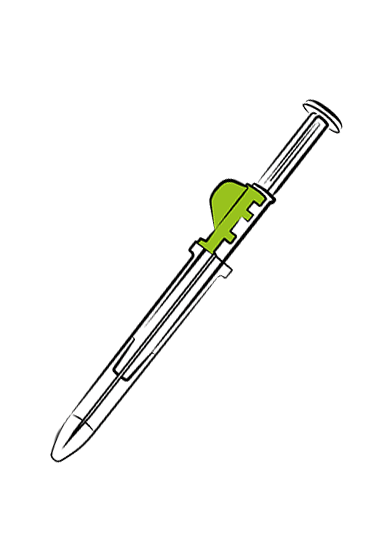
After removing the safety clip and protective cap, the doctor positions the implant syringe and performs a subcutaneous injection into the puncture channel. Depressing the plunger fully, the implant is delivered into the needle channel initially, and then the needle automatically retracts from the tissue into the integrated needle guard. This ensures prevention of needle-related injuries and minimizes infection risks. Finally, the syringe can be disposed of properly.

Packaging Variants
The implant syringe is available in two sizes in its standard configuration:
Implant diameter 1,2 mm
Length 11,0 mm-19,5 mm
Implant diameter 1,5 mm
Length 11,0 mm -19,5 mm
Do you have any questions about possible custom modifications or production standards?
Benefits
Filling
The implant syringe is delivered ready-to-fill in two assemblies:
At the customer’s or white-label producer’s facility, the implant is inserted from the rear into the syringe body (BG1) or into the depot, and then finally assembled with the plunger (BG2).
The implant syringe can be sterilized as follows:
Frequently Asked Questions
A prefilled syringe (PFS) can offer advantages for long-acting injectable (LAI) and depot injections by reducing the number of preparation steps and supporting consistent dose delivery.
Compared to vial-and-syringe systems, prefilled syringes may eliminate multiple manual handling steps, which can help reduce variability in dose preparation. This is particularly relevant for depot injections, where precise administration is essential for the intended use of the medicinal product.
Potential benefits of PFS systems include:
– Enable faster and more efficient clinical workflows
– Reduced handling steps that may lower the risk of preparationrelated errors
– Support high-value biologics and hormone therapies
– Reduce drug and device waste
As a result, pfs prefilled syringes may increasingly be used for long-acting injectable drugs and advanced injectable pharmaceutical packaging.
An implant syringe is designed for the administration of solid or semi-solid implants, whereas standard prefilled syringes for subcutaneous injection are designed for liquid formulations.
Key distinguishing features include:
– Needle or cannula geometries adapted for implant delivery
– Designed to support controlled implant placement during administration
Unlike conventional prefilled syringes, implant syringes are configured to facilitate the correct positioning of the implant within the subcutaneous tissue, as required for the intended use of the medicinal product.
This is relevant for therapies such as hormone-based depot injections, where the implant is designed to release the active substance over a defined period.
Modern safety syringes incorporate mechanisms intended to reduce the risk of accidental needlestick injuries during or after injection. Common safety features include:
– Retractable needles (manual or automatic activation)
– Auto retractable syringe designs
– Safety-lock mechanisms
– Needle-shielding or needle-cover systems
These features are designed to activate during or immediately after injection process, ensuring that the needle is either covered or fully retracted according to the device’s intended function.
Retractable safety syringes and self-retracting needles can help reduce the risk of needlestick injuries, which are recognized as an occupational hazard in healthcare settings.
For this reason, safetyengineered syringe devices may increasingly be used in clinical practice in accordance with institutional and regulatory requirements.
Depot injection and implant injection both rely on formulations that are administered subcutaneously and are designed to release the active substance gradually over a defined period.
This controlled-release mechanism is achieved through formulation technologies such as biodegradable polymers (implant) or crystalline suspensions (depot).
Characteristics commonly associated with these systems include:
– Sustained drug release over weeks or months
– Reduced dosing frequency
– Potential support for less frequent administration schedules
Depot and implantbased delivery approaches are used in therapeutic areas such as:
– Hormonerelated treatments
– Oncology applications
These depot or implant injections are established components of long-acting injectable medicinal products.
Implant and depot syringes can be filled using advanced processes such as backload filling, which allows precise dosing under controlled sterile conditions.
This approach is typically implemented through a network of specialized pharmaceutical companies or CMOs (Contract Manufacturing Organizations), enabling flexible and scalable production.
Additionally, by leveraging our partner network for pfs filling, pharma companies can accelerate time-to-market while maintaining high quality and regulatory compliance.
Drug-device systems such as implant syringes and prefilled syringes (PFS) must comply with multiple regulatory key frameworks:
EU (Europe):
EU MDR 2017/745 (Medical Device Regulation)
Notified Body involvement for device components
Clinical evaluation and post-market surveillance
With regards to the GAPLAST Implant Syringe, the CE certification (EU MDR 2017/745) is currently pending.
ISO Standards:
ISO 11040 – Relevant parts may apply depending on syringe design and filling configuration
ISO 11608 – Needle-based injection systems – partially applicable for GAPLAST Implant Syringe
ISO 15378 – Primary packaging materials for pharmaceuticals
ISO 13485 – Medical Devices
USA (FDA):
21 CFR 820 / QMSR – Device quality systems
Human Factors Engineering requirements
With regards to the GAPLAST Implant Syringe, the 21 CFR 820 / QMSR is currently pending.
Compliance with applicable regulatory and quality standards supports product safety, performance, and global market access for pfs in pharma applications.
If you require more detailed information on regulatory compliance, please contact us.
The implant syringe is registered and approved in several key international markets, supporting global commercialization of implant injection and depot injection therapies.
Key regulatory statuses include:
– China: Registered with the China National Medical Products Administration (NMPA)
– Russia: Approved under local regulatory requirements for medical devices and combination products
– Europe: Compliance with the EU MDR (Medical Device Regulation 2017/745) is currently under review and has not yet been granted
These registrations demonstrate alignment with applicable regulatory requirements related to:
– Safety and performance
– Quality and manufacturing standards (GMP)
– Clinical and usability evaluation
For pharmaceutical companies and CMOs, this global regulatory footprint offers:
– Faster market access
– Reduced regulatory risk
– Easier integration into international development programs
Implant syringes are used for the controlled delivery of implants into subcutaneous tissue in clinical practice. Depending on the indication and procedure, they may be used in settings where trocar-based administration techniques are also applied, in line with product-specific and clinical requirements.
They support standardized implant administration within established medical workflows.
Key features include:
– Defined placement of the implant within subcutaneous tissue
– Controlled injection process to support reproducibility
– User-oriented design intended to simplify handling
– Delivery mechanism designed to support consistent application
Overall, implant syringes provide a standardized option for implant administration in appropriate clinical settings and may be considered where different administration techniques are used within the same therapeutic area.
A stable and scalable process for implant syringe systems is achieved through a strong, well-integrated partner network that covers all critical steps along the value chain. This includes close collaboration with:
– Contract Manufacturing Organizations (CMOs) for GMP-compliant production
– Cannula and needle manufacturers to ensure optimized injection performance
– Filling and assembly partners for precise, automated filling processes
– Qualified sterilization partners supporting product safety and applicable regulatory requirements
Each syringe is supplied with comprehensive batch documentation, enabling seamless integration into pharmaceutical manufacturing and quality systems.
For more information or to explore your specific requirements, feel free to reach out. We’re happy to continue the conversation.
Implant syringes are designed to support a range of specialized drug formulations used in long-acting injectable (LAI) and drug loaded, implant-based therapies.
Formulation types that can be supported include:
– Solid implants or depots (e.g. polymer-based rods)
– Biodegradable polymer systems
These formulation approaches are typically developed to enable prolonged drug release over defined time periods, such as several weeks or months, depending on the medicinal product.
Implant syringe systems may be used in therapeutic areas where long‑acting or implant‑based delivery is relevant, including:
– Hormone therapies
– Oncology treatments
– Chronic disease management
– Veterinary medicine
When using prefilled syringes (PFS), depot syringes or implant syringes, it is essential to follow all instructions provided by the manufacturer to ensure correct and safe handling.
Users must always adhere to:
– The approved Instructions for Use (IFU)
– The manufacturer’s handling and preparation guidelines
– The labelling and packaging information relevant to the specific product
These documents define the intended use, preparation steps, administration technique, and any precautions or limitations associated with the device–medicinal product combination. Following them helps ensure that the product is used as designed and in accordance with applicable regulatory requirements.